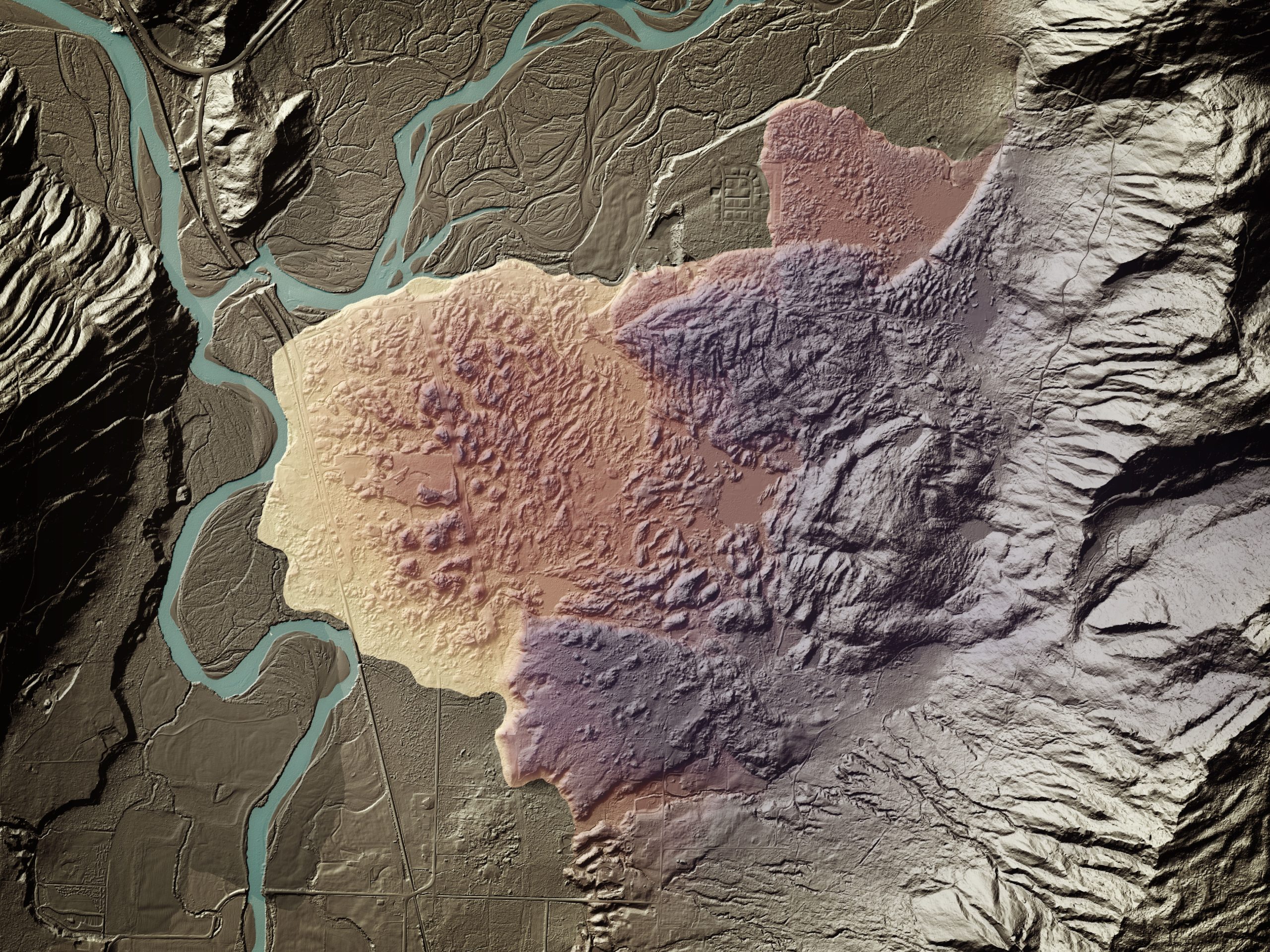
A bioregion is, in its simplest formulation, a life-place. The word itself is instructive: bio from the Greek bios (life), region from the Latin regia (territory). Etymologically, a bioregion is a life territory. Every person, animal, and plant lives in one. It is a geographical area defined not by political agreements but by the patterns of the living world: its watersheds, soils, elevation, climate, plant and animal communities, and the human cultures that have grown in relationship with these features over time.
This page treats the bioregion as a unit, the where of bioregional practice. The companion essay at What Is Bioregionalism? treats the field, the movement, and the philosophy. Here the question is narrower. What, precisely, is a bioregion? How is it distinguished from an ecoregion, a watershed, or a state? What are its layers, and how do they fit together?
Origins of the Term
The contemporary use of the word bioregion was coined in the early 1970s, principally by Peter Berg and the ecologist Raymond Dasmann working through the Planet Drum Foundation in San Francisco. Their 1977 essay “Reinhabiting California” gave the field its founding definition: a bioregion is “both geographical terrain and a terrain of consciousness, a place and the ideas that have developed about how to live in that place.” That layered formulation, geographical and cultural at once, has shaped every subsequent attempt to define what a bioregion actually is. For the deeper lineage of thinkers, texts, and gatherings that built the term into a movement, see History of Bioregionalism; this page focuses on what the unit itself contains.
The Layered Definition
A bioregion is not one thing. It is a stack of interwoven layers, and the stack matters as much as any single layer in it. At the Symposium on Biodiversity of Northwestern California in 1991, Peter Berg offered one of the most widely cited elaborations:
A bioregion can be determined initially by the use of climatology, physiography, animal and plant geography, natural history and other descriptive natural sciences. The final boundaries of a bioregion are best described by the people who have lived within it, through human recognition of the realities of living-in-place.
Peter Berg, 1991
David McCloskey, the Seattle University sociologist who named the Cascadia bioregion, frames the analysis in three levels: physical, biological, and cultural. The physical layer maps landforms, geology, climate, and hydrology. The biological layer maps the flora and fauna and their habitats. The cultural layer maps native peoples, settlement patterns, and current land use, in interaction with the first two.
The Physical Layer
Bioregions are defined, first, by the slow grinding of plate tectonics that builds the bones of the earth. From those collisions come the hard lines of a place: volcanoes, mountain ranges, faults, subduction zones, and ridges. From those hard foundations, water, wind, and rain are guided and directed, depositing soils, feeding ecosystems, and creating the conditions in which forests, grasslands, wetlands, and marine environments develop.
- Geology, tectonics, and plate boundaries
- Topography, mountain ranges, ridgelines, and continental divides
- Hydrology: watersheds, rivers, aquifers, ocean currents, tidal patterns
- Climate, precipitation, wind patterns, seasonal cycles
- Soil types, erosion patterns, mineral composition
These features are visible from space: the green corridors of river systems, the spines of mountain ranges, the blue reach of coastal shelves. They are not imposed on a map. They arise from a physical geography active for millions of years.
The Biological Layer
From the physical foundation rise the living systems: ecoregions and biomes, plant communities and old-growth forests, animal populations and migratory corridors, marine ecosystems and nearshore habitats, keystone species and food webs. The biological layer is where habitat connectivity, breeding grounds, and migration patterns reveal themselves as the working circulation of a place.
Bioregions are not only for humans. What is the bioregion of a monarch butterfly, a humpback whale, a salmon, a migratory bird? These creatures rely on interconnected habitats that span vast distances and cross many human-imposed borders. The Southern Resident orca whales of the Salish Sea feed almost entirely on Chinook salmon, which rely on forage fish, which feed on zooplankton, which depend on phytoplankton. The Chinook themselves require healthy spawning streams throughout the Fraser and Columbia River watersheds, far inland to the Rocky Mountains. To map the bioregion of the Southern Resident orca, the line cannot stop at the shoreline.
The Human and Cultural Layer
The cultural layer is what distinguishes a bioregion from an ecoregion. It includes indigenous territories, languages, governance systems, and traditional ecological knowledge; settlement patterns, infrastructure, food systems, agriculture, and local economies; culture, art, music, story, and shared identity; political boundaries, land-use patterns, energy systems, and waste streams; and time, the long arc by which a place is inhabited, damaged, and healed.
Indigenous peoples have inhabited particular places for thousands of years, evolving ways of life adapted to local conditions. Bioregionalism, as the educational materials of Planet Drum put it, “is new only for people who come out of the Western industrial-technological heritage. The essence of bioregionalism has been reality and common sense for native people living close to the land for thousands of years.” Dr. Dan Longboat (Roronhiakewen) of Trent University frames the bridging aspiration directly: bioregionalism means “weaving the best of indigenous ecological knowledge and wisdom, with the best that science can offer.”
Gary Snyder named the literary dimension when he described bioregions as story-regions, places defined as much by the narratives, songs, and place-names of their inhabitants as by their watersheds and ridgelines. Reinhabitation, in Berg’s phrase, is the practice of becoming aware of the relational web of a bioregion’s ecological qualities and inhabitants. It is the work of learning a place well enough to live in it without breaking it.
Bioregion, Ecoregion, Watershed
Maintaining the distinction matters. Ecoregions are areas that share similar ecological characteristics: a particular suite of plant communities, wildlife, soils, and climate. Watersheds are the drainage basins through which water flows, from ridgeline to river mouth. A bioregion is composed of many ecoregions and many watersheds, and it includes the human and cultural systems that have arisen in that physical and biological context. Bioregional maps include people; ecoregional maps tend to focus on natural communities and often exclude human activity.
If a bioregion is a house, then ecoregions and watersheds are its rooms. A bioregion is smaller than a continent but larger than any single ecoregion or watershed. It is not a state, county, or single ecosystem. If what someone calls a bioregion is actually a part of a larger interconnected system whose wholeness is being excluded, it is likely not a bioregion but a component within one.
Four Thresholds for a Bioregion
Across the network of bioregional movements, practitioners have aligned around four thresholds for determining whether a given territory constitutes a bioregion. They are offered not to constrain the idea but to keep it coherent.
- It is a land and water territory defined by the natural realities of place and the communities within it, the largest scale where connections based on physical place still make sense.
- It is large enough and small enough. Large enough to maintain the integrity of its biological communities and to support migration, nutrient cycling, and stream flow. Small enough for residents to consider it home. It does not stop at the shoreline.
- Watersheds are foundational. A bioregion may extend across multiple watersheds, but it must never divide them.
- People matter. A bioregion is shaped by the communities that live there. Humans are a keystone species and belong inside the visions, plans, and maps of place.
Nested Scales and Governance
Bioregions exist at nested scales, each embedded in the ones above and below. A healthy bioregion is composed of healthy ecoregions, healthy landscapes, healthy watersheds. Peter Berg framed it this way: ecologies ascend in scale from the local ecosystem, to the watershed, to the bioregion, and onward to continent and planet.
- Planet, the biosphere
- Continent, defined geologically by the continental crust
- Bioregion, shaped by continental divides and large hydrological basins
- Major watershed, the river systems and arteries of a bioregion
- Ecoregion or ecosystem, areas sharing similar ecological characteristics
- Smaller watersheds, the sub-basins where most landscape work sits
- Discrete landscape, where individuals and households take direct action
Governance follows the same nested logic. Watershed councils, sub-bioregional bodies, bioregional congresses, and continental confederations have all emerged from this thinking. The first North American Bioregional Congress, held in 1984 near Kansas City, brought together nearly three hundred delegates and used Quaker consensus rules to draft resolutions on agriculture, forestry, water, indigenous peoples, culture, and ecological defense. Subsequent congresses through 2009 deepened the practice and reinforced the principle that bioregional governance is built from the ground up.
Political boundaries intersect a bioregion without defining it. Counties, states, provinces, and national borders cut across watersheds and biological communities that operate at different scales. The bioregional response is not to abolish these jurisdictions but to recognize that they cannot, on their own, manage what is bioregional in nature. Forest fire, flooding, drought, salmon, energy, food: no single state or province solves these alone. Bioregional frameworks sit alongside existing political ones, informing land-use decisions, climate adaptation, and stewardship at the scale where the underlying systems actually operate.
Bioregions Around the World
The bioregional concept is universal, even though the work of mapping and inhabiting bioregions is uneven and ongoing. Planet Drum’s early Bundles, from 1973 onward, profiled places as varied as the North Pacific Rim, the Hudson Estuary, and the Rocky Mountain backbone. The Ozarks Area Community Congress, founded in 1980, organized around the distinct ecology and culture of the Ozark plateau. Bioregional bodies now exist across North America, Europe, Latin America, Australia, and parts of Africa and Asia. Cascadia, the bioregion of the Pacific Northwest, is one well-developed example among many. There is no master map of the world’s bioregions, because that map has not yet been made. The work of defining, mapping, and inhabiting belongs to the people who live in each place.
Why a Shared Definition Matters
As the term bioregion enters wider use, the risk of dilution rises. Without a shared definition, the word can be borrowed to describe almost anything: a state, a marketing region, a corporate sustainability zone, a single watershed treated as if it were the whole. A shared definition is how practitioners across geographies recognize one another as working on the same problem, and how the term resists co-optation by institutions that would prefer to use the language without rebuilding the underlying systems. Bioregions are the natural countries of the planet. Defining them, mapping them, and learning to inhabit them well is the long work of a generation, and the next, and the next.
From Unit to Practice
Bioregions are the unit. Bioregionalism is the practice. Once the territory is named and its layers understood, the question becomes how to live in it well: how to organize governance, food, energy, and economy in alignment with what the bioregion actually is and what it can sustain. For the lineage of thinkers who shaped this field, see History of Bioregionalism. For the values that guide the work, see Principles of Bioregionalism. For what is happening on the ground today, see Bioregionalism in Action.